AI Is Quietly Taking Over Market Forecasting — This Open-Source Project Uses Thousands of AI Agents to Predict the Stock Market
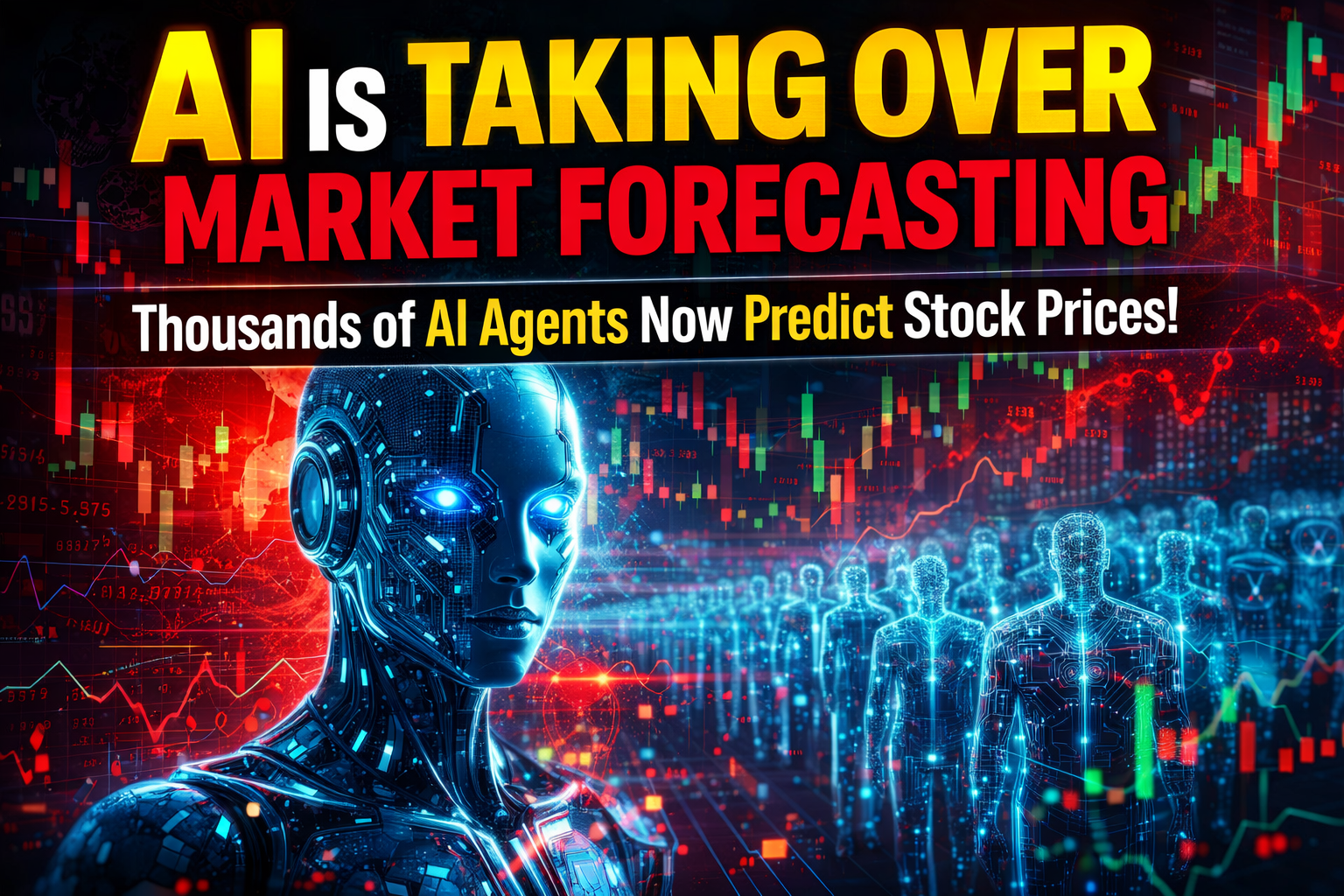
A controversial new open-source AI project is shaking the financial world. Developers claim it can deploy thousands of AI agents simultaneously to forecast stock market movements, potentially changing how traders, hedge funds, and investors analyze markets.
But the rise of AI-driven market prediction tools is also raising uncomfortable questions. Could algorithmic intelligence dominate financial forecasting? Will retail traders be left behind? And could thousands of automated agents manipulating predictions actually destabilize markets?
As AI in finance accelerates at breakneck speed, this experimental open-source platform is becoming one of the most talked-about developments in algorithmic trading, AI stock prediction, and automated investment strategies.
What Is the Open-Source AI Market Forecasting Project?
The project is designed as a multi-agent AI system, where thousands of independent artificial intelligence agents analyze market data simultaneously.
Instead of relying on a single prediction model, the platform runs hundreds or thousands of AI models in parallel, each analyzing different financial signals such as:
- Stock price movements
- Economic indicators
- Global market news
- Social media sentiment
- Trading volume and liquidity
- Derivatives market data
Each AI agent generates its own forecast. The system then aggregates the predictions to form a collective market outlook, similar to a crowd-sourced intelligence model.
This concept is often referred to as AI swarm forecasting or multi-agent market intelligence.
Why Thousands of AI Agents Are Being Used
Traditional machine learning trading models rely on a single neural network or algorithm to forecast price movements.
But markets are complex and constantly evolving. Developers behind the project argue that using thousands of AI agents offers several advantages:
1. Diverse Market Perspectives
Each AI agent can be trained on different datasets or strategies.
Some agents focus on:
- technical analysis signals
- macro-economic indicators
- order flow and liquidity data
- news sentiment analysis
This diversity creates a more robust prediction system.
2. Reduced Model Bias
Single AI models can become biased or overfit historical data.
By combining predictions from thousands of agents, the system attempts to reduce the risk of model bias and overfitting, producing a more balanced market forecast.
3. Real-Time Adaptive Intelligence
The AI agents continuously update their forecasts as new data arrives.
This allows the system to respond quickly to:
- breaking financial news
- sudden market volatility
- geopolitical events
- interest rate announcements
In theory, this could create a real-time adaptive forecasting engine.
Why This AI Forecasting System Is Raising Concerns
Despite its technological promise, the project has sparked serious debate among financial experts.
Fear #1: AI Could Dominate Market Forecasting
Large hedge funds already use advanced AI trading algorithms.
But open-source AI systems capable of deploying thousands of agents could democratize — or destabilize — market prediction.
If such systems become widely accessible, markets could become hyper-competitive and algorithm-driven.
Fear #2: Market Predictions Could Become Manipulated
Some analysts warn that open AI forecasting systems could be abused.
If malicious actors manipulate the data used by AI agents — such as:
- fake news signals
- coordinated social media sentiment
- manipulated market data
then the AI forecasts could become distorted.
This risk is known as AI model poisoning.
Fear #3: Retail Traders May Misinterpret AI Signals
Many retail traders already rely on:
- AI stock prediction apps
- automated trading bots
- algorithmic trading indicators
But AI predictions are probabilistic, not guaranteed outcomes.
Experts warn that blindly following AI forecasts could lead to major trading losses, especially in volatile markets.
Why AI Is Rapidly Transforming Financial Markets
Artificial intelligence is already deeply embedded in global finance.
Today AI is widely used for:
- algorithmic trading
- risk management
- portfolio optimization
- high-frequency trading
- market sentiment analysis
Major hedge funds and investment firms are investing billions in AI financial technology.
As computing power increases, the next frontier may be massive multi-agent AI systems capable of analyzing markets at unprecedented scale.
Could AI Replace Traditional Market Analysts?
The rise of AI forecasting tools has also triggered debate about the future of financial analysis.
Some experts believe AI systems may eventually outperform human analysts in areas such as:
- pattern recognition
- large-scale data analysis
- real-time signal detection
However, many economists argue that markets are influenced by human behavior, psychology, and unexpected events, which AI models still struggle to predict reliably.
In reality, the future may involve hybrid systems combining human judgment with AI analysis.
The Future of AI-Driven Market Prediction
The open-source project using thousands of AI forecasting agents represents an early glimpse into the future of financial intelligence.
If successful, similar systems could become widely used across:
- hedge funds
- quantitative trading firms
- crypto trading platforms
- retail trading tools
However, as AI becomes more powerful in financial markets, regulators may also step in to ensure that algorithmic trading and AI forecasting systems do not destabilize markets.
Final Thoughts
The emergence of open-source AI platforms deploying thousands of market-forecasting agents signals a major shift in how financial predictions are generated.
While the technology promises deeper insights and faster analysis, it also raises difficult questions about market fairness, manipulation risks, and the growing influence of artificial intelligence in finance.
For traders and investors, the message is clear: AI may become a powerful tool — but relying on it blindly could be dangerous.