
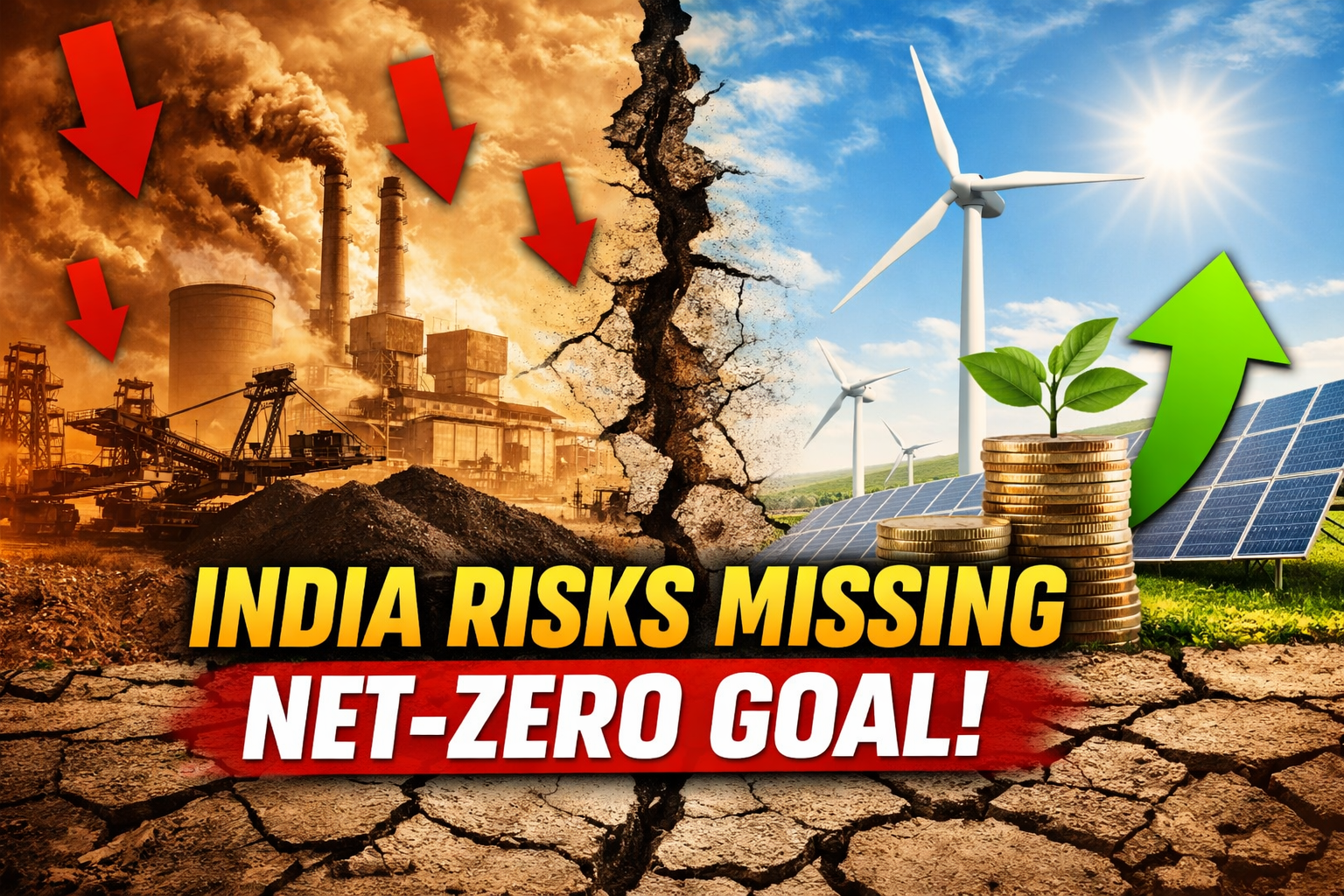
Green Growth Crisis: Why India’s Lack of a Transition Finance Institution Could Derail Its Net-Zero Dreams
India’s ambitious green growth agenda is facing a silent but dangerous obstacle. While policymakers repeatedly emphasize climate action, renewable energy expansion, and sustainable infrastructure, a critical financial gap threatens to derail the country’s transition to a low-carbon economy.
Experts warn that India still lacks a dedicated transition finance institution, a specialized body designed to fund industries shifting from high-carbon to low-carbon operations. Without such an institution, India’s green ambitions could remain more of a policy slogan than a real economic transformation.
As climate pressures mount and global investors increasingly demand ESG compliance, green finance frameworks, and climate-aligned investment, India risks falling behind in the race for sustainable growth.
India’s Green Growth Push Faces a Financing Bottleneck
Over the past decade, India has positioned itself as a global leader in renewable energy expansion and climate commitments under the Paris Agreement. The government has pledged massive investments in solar power, green hydrogen, electric mobility, and climate-resilient infrastructure.
However, there is a major structural problem.
Most of India’s emissions come from hard-to-abate sectors such as:
- Steel
- Cement
- Thermal power
- Heavy manufacturing
- Transport and logistics
These sectors cannot simply shut down overnight. Instead, they require transition finance — funding specifically designed to help companies gradually move toward cleaner technologies without collapsing economically.
Without a specialized financial mechanism, many companies are trapped between climate pressure and capital shortages.
What Is Transition Finance — And Why It Matters
Transition finance refers to targeted capital that supports carbon-intensive industries in reducing emissions over time.
Unlike traditional green finance, which funds fully sustainable projects such as solar or wind farms, transition finance supports industries that are not yet green but are willing to transition.
Examples include:
- Steel plants adopting hydrogen-based production
- Coal power plants retrofitting carbon capture technology
- Cement manufacturers reducing clinker emissions
- Shipping companies adopting green fuels
Global institutions like the World Bank and International Monetary Fund have increasingly emphasized the importance of transition finance for developing economies.
Yet India still lacks a central institution dedicated to managing this financial transformation.
Why Existing Institutions Are Not Enough
India’s current financial ecosystem includes multiple public institutions such as:
- Reserve Bank of India
- National Bank for Financing Infrastructure and Development
- Indian Renewable Energy Development Agency
But experts argue these institutions focus primarily on traditional infrastructure financing or pure renewable energy projects.
They do not adequately address the complex financing needs of industries undergoing decarbonization.
Transition projects often face three major challenges:
- High upfront capital costs
- Technology uncertainty
- Long payback periods
Commercial banks are often reluctant to fund such projects due to risk concerns and regulatory limitations.
The Dangerous Gap in India’s Climate Strategy
India aims to achieve net-zero emissions by 2070, a goal that requires trillions of dollars in investment.
However, climate economists warn that without a dedicated transition finance institution, the country may face several risks:
1. Stranded Industrial Assets
Coal plants, steel factories, and heavy manufacturing facilities could become stranded assets, leading to economic shocks and job losses.
2. Slow Decarbonization
Industries unable to access affordable financing may delay emissions reduction, putting India’s climate commitments at risk.
3. Loss of Global Investment
International investors increasingly favor countries with clear green finance frameworks and transition finance policies.
Without such mechanisms, India may lose access to global climate capital and ESG funds.
Why India Needs a Specialized Transition Finance Institution
Experts suggest India should create a dedicated Transition Finance Corporation, similar to climate financing institutions emerging in Europe and East Asia.
Such an institution could:
Provide Low-Cost Green Transition Loans
Industries transitioning to cleaner technologies need patient capital with longer repayment timelines.
Reduce Investment Risk
Government-backed guarantees could encourage private investors and banks to participate in decarbonization projects.
Develop Clear Transition Taxonomies
A transition finance institution could establish standards defining which projects qualify for transition funding, preventing greenwashing.
Mobilize Global Climate Funds
India could attract billions from international climate funds and development banks.
Global Competition for Green Capital Is Intensifying
Countries across the world are racing to build green finance ecosystems.
For example:
- Japan has launched transition bonds for heavy industry decarbonization
- The European Union has developed detailed sustainable finance taxonomies
- China has created massive state-backed green investment vehicles
Without similar mechanisms, India could struggle to compete for global ESG investment flows.
The Stakes for India’s Economic Future
India’s economic growth strategy increasingly depends on green manufacturing, clean energy supply chains, and climate-friendly infrastructure.
But the transition from fossil-fuel dependence to a sustainable economy cannot happen without financial architecture designed for transition risk.
Experts estimate that India may need over $10 trillion in climate investment by 2070.
Without a dedicated transition finance institution, this massive capital requirement could remain unmet.
A Warning Signal for India’s Green Growth Vision
India’s green growth narrative is powerful, but policy ambition without financial infrastructure could undermine the entire transition.
Creating a specialized transition finance institution may be one of the most urgent reforms required to ensure India’s climate commitments translate into real economic transformation.
Without it, the country risks facing a green growth paradox — big climate promises but insufficient financing to achieve them.

Related Posts

Moon Trading Strategy: How to Trade by Observing the Moon

Wall Street’s Next Dangerous Obsession? Why ‘Agentic AI’ Software Is Becoming the US Stock Market’s Most Disruptive Tech Frontier