
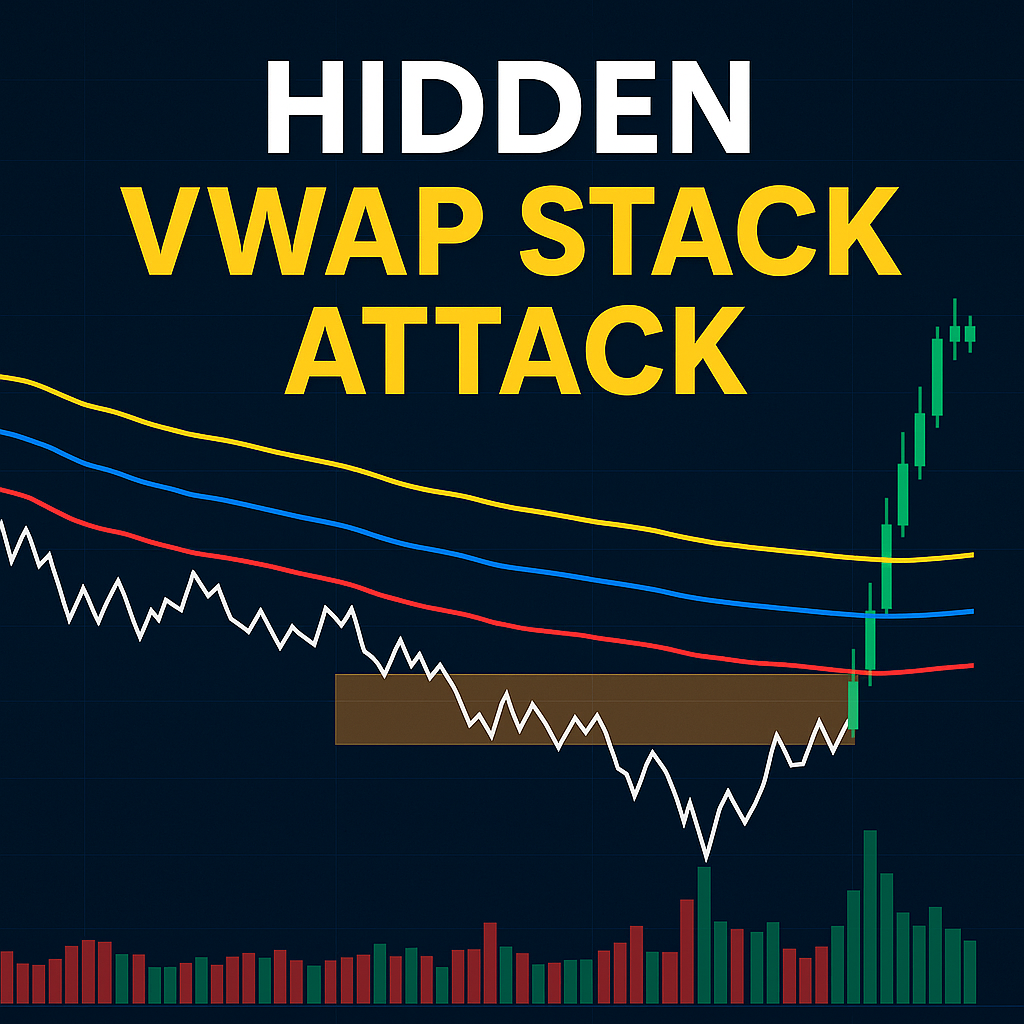
Hidden VWAP Stack Attack — A deep dive, tactics, and trade plan
The Hidden VWAP Stack Attack is a short-term intraday tactic that seeks edges where multiple VWAP anchors (session VWAP, anchored VWAPs, rolling VWAPs) line up (a “stack”), then uses price behaviour (liquidity sweeps, micro structure, volume spikes, order blocks) to enter on the ensuing move when institutions or algos “attack” that stacked fair-value shelf. You trade the rejection or the sweep-and-rally following the stack, using strict entries, volume confirmation, and tight risk management. Key references: Investopedia on VWAP, TradingView VWAP implementations, and practical writeups on confluence trading. Investopedia+2TradingView+2
What “VWAP Stack” and “Stack Attack” mean
- VWAP (Volume Weighted Average Price) — the intraday price average weighted by volume; acts as a dynamic institutional benchmark and intraday “fair value”. Investopedia
- VWAP Stack — several VWAP lines or anchors that coincide closely in price: e.g., today’s standard VWAP, an anchored-VWAP from the previous day’s high, and a 2-day anchored VWAP all converging within a small price range. Confluence increases the chance that large participants treat that price as meaningful. TradingView+1
- Stack Attack — the market event where price attacks that stacked zone to sweep liquidity (trigger stop orders/limit orders) and then reverses (liquidity grab) or breaks through with institutional follow-through. Traders can profit by either fading the liquidity sweep (mean reversion) or by entering after breakout confirmation (momentum). Practical writeups combining VWAP with volume profile/anchored VWAP show these dynamics. Trader Dale’s Volume Profile Trading+1
Why it works (market microstructure view)
- Institutional anchoring: Institutions and algos often use VWAP to split executions and to judge “fair value”; stacked VWAPs create clustered execution interest. Investopedia
- Liquidity concentration: When multiple benchmarks align, many stop/limit orders cluster nearby — becoming attractive liquidity for algos to hunt (sweep) before the larger move. TradingView
- Order-flow reaction: After a sweep, either (A) short-term liquidity takers get exhausted and price mean-reverts to the VWAP cluster (fade), or (B) follow-through buying/selling from institutions turns the sweep into a breakout. Correctly reading which occurs is the edge. XBrat Trading Indicators & Tools
Ingredients you’ll need (tools & charts)
- VWAP(s): standard intraday VWAP + at least one anchored VWAP (e.g., anchored to prior day open, overnight high/low, or swing high/low). Most platforms (TradingView, IB, thinkorswim) have VWAP tools. TradingView+1
- Volume and Volume Profile/POC for confluence (shows where executed volume clustered). Trader Dale’s Volume Profile Trading
- Shorter TF price action (1–5 min) for entries; higher TF context (15–30m) for trend/bias. Algofin Tech Services
- Optional: orderflow prints / DOM / tape for more precise execution (if available).
Exact setup: Hidden VWAP Stack Attack (step-by-step)
This is a practical, repeatable recipe. Use a demo account first.
1) Identify a stack (context)
- On a 15–30m chart, locate a confluent zone where at least two VWAP lines (standard VWAP + one or more anchored VWAPs or rolling VWAP windows) and/or Volume Profile high-volume node/POC co-locate within ~0.2–0.6% for liquid assets (wider for illiquid). Mark as VWAP Stack Zone. TradingView+1
2) Decide approach by bias
- If price is above the stack and higher timeframes show bullish structure → treat the stack as support (look to buy rejections or sweep-and-hold).
- If price is below the stack and HTF structure is bearish → treat it as resistance (look to short rejections).
- If structure is unclear → prefer smaller size or avoid.
3) Watch for attack signals (entry triggers)
Use one or more of the following on 1–5m for trigger:
- Liquidity sweep + quick wick through stack followed by a swift rejection candle (liquidity grab). Enter on the first clean price reclaim/back inside the stack with bullish/bearish confirmation candle.
- Volume spike at the stack with either continuation (enter on breakout retest) or reversal (enter fade after rejection candle). XBrat Trading Indicators & Tools+1
- Anchored VWAP cross — e.g., price reclaims an anchored VWAP that was previously acting as resistance; enter on pullback to it. YouTube
4) Entry & sizing
- Entry: aggressive — at the reclaim of the stack with a microstructure candle and on-volume; conservative — wait for a pullback/retest inside the zone.
- Position size: small enough that stop loss is 0.25–0.75% (liquid names) or fixed ATR multiple (e.g., 0.5 ATR). Adjust size so risk per trade is a small % of account (e.g., 0.25–1%).
5) Stop & targets
- Stop: beyond the wick/low that invalidated the reclaim or beyond the stacked zone (give enough to avoid noise).
- Targets: short-term mean reversion → VWAP median or next anchored VWAP; momentum breakout → use 1:1.5 to 1:3 R:R targets or trail with VWAP or ATR. Always trail stops to lock gains.
6) Execution rules (practical)
- Do not add after a failed retest unless structure re-aligns.
- Prefer liquid instruments (high ADV) — VWAP behaves better there. Investopedia
- Avoid trading during major macro prints (economic news) unless you have special event rules.
Variations & advanced tactics
- Multi-day anchored VWAP stack: anchor VWAPs to previous day high/low and 2-day opens to create multi-session stacks — useful for gap fills and opening-drive strategies. YouTube
- VWAP + Order Block + FVG (Fair Value Gap): combine order-block (institutional imbalance) or FVG with VWAP stack for higher probability setups. ForexBee
- Volume-profile confluence: treat a stacked VWAP near a high-volume node/POC as stronger than a VWAP alone. Trader Dale’s Volume Profile Trading
How to backtest the Hidden VWAP Stack Attack
- Define rules precisely (stack distance threshold, TFs, entry candle, stop placement, size).
- Use intraday historical data (tick or 1-min) because VWAP and volume behaviour are time-sensitive. Platforms: TradingView (Pine), Python with vectorbt/backtrader + intraday data. TradingView
- Simulate market impact and slippage — intraday liquidity grabs often fill aggressively; factor in realistic slippage.
- Measure metrics: win rate, avg R:R, expectancy, max drawdown, trade frequency. Iterate.
Psychology & edge management
- The edge is microstructure + confluence — don’t overtrade. Trade only when the stack aligns with higher-timeframe bias or when volume/orderflow provides confirmation.
- Accept a small number of high-quality setups — stacked VWAPs do not appear every bar.
- Keep a trade journal: record the stack composition, entry trigger, and why you took the trade.
Risk & limitations
- Low-liquidity instruments: VWAP behaves poorly; stacked signals can be false. Investopedia
- News and scheduled events can blow through VWAP stacks with no meaningful retrace. Conservative to pause around high-impact releases.
- Curvefit risk: designing overly-specific stack-distance or anchor combinations can overfit historical data. Backtest broadly.
Sample checklist (pre-trade)
- Higher TF structure: Bull / Bear / Neutral.
- VWAP Stack Zone marked (which VWAPs anchored?).
- Volume profile / POC confluence?
- Entry trigger: sweep + rejection OR retest after breakout?
- Position size & stop defined.
- News calendar clear for next 30 minutes.
- Execute with limit/stop orders and log trade.
Example resources and further reading (external links embedded on keywords)
- VWAP fundamentals — Investopedia: Mastering VWAP. (Good conceptual primer). Investopedia
https://www.investopedia.com/ask/answers/031115/what-common-strategy-traders-implement-when-using-volume-weighted-average-price-vwap.asp - TradingView VWAP scripts & anchored VWAPs — community scripts and examples. TradingView
https://in.tradingview.com/scripts/vwap/ - Anchored VWAP & Volume Profile practical ideas — Trader Dale (anchored VWAP + VP use cases). Trader Dale’s Volume Profile Trading
https://www.trader-dale.com/day-trading-with-anchored-vwap-and-volume-profile-17th-jul-2024/ - VWAP strategies roundup — HighStrike guide to VWAP strategies (modern writeup). HighStrike Trading
https://highstrike.com/vwap/ - VWAP entry strategies — LuxAlgo blog on practical VWAP entries. LuxAlgo
https://luxalgo.com/blog/vwap-entry-strategies-for-day-traders/
Quick checklist to begin practicing tomorrow
- Add standard VWAP + two anchored VWAPs (prior-day high and prior-day open).
- Add volume profile for session or 30-min slices.
- Scan 15–30m charts for stacks. Mark them and wait for 1–5m entry triggers.
- Use demo/backtest for 30–60 trades before risking live capital.
Closing notes
Hidden VWAP Stack Attack is not a magic bullet — it’s an organized way to use confluence of VWAP benchmarks + volume/orderflow to identify where large participants likely interact with price. With disciplined rules, position sizing, and honest backtesting (including slippage), it can be a robust intraday edge.




3 thoughts on “Hidden VWAP Stack Attack — A deep dive, tactics, and trade plan”