
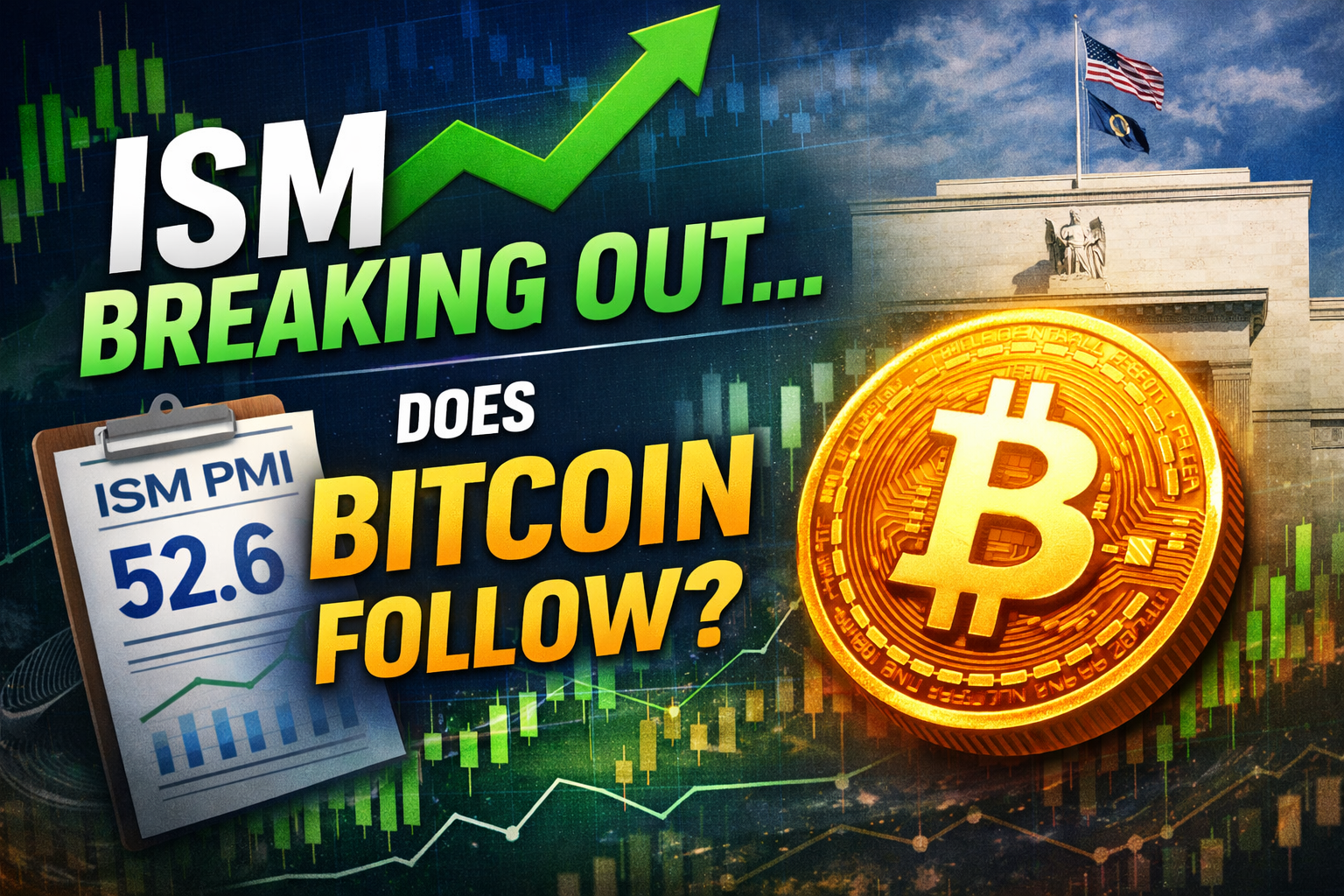
Institute for Supply Management breaking out — does Bitcoin follow?
January 2026’s ISM Manufacturing PMI surprised to the upside (52.6), flipping back into expansion after months of contraction. Markets treated it as a reflation / risk-on signal — equities popped, some analysts called it bullish for Bitcoin, while skeptics flagged weak historical causality and important lags/offsetting channels. In short: a strong ISM can help create a macro environment that’s favorable for Bitcoin, but it is neither necessary nor sufficient — use it as one input among liquidity, rates, USD strength, and on-chain signals.
1) What just happened (the data)
January 2026’s ISM Manufacturing PMI jumped to 52.6 — its highest reading since mid-2022 and a clear move above the 50 expansion threshold. The headline move was driven by a surge in new orders and production, while employment stayed weak and inventories tightened. Stock markets reacted positively to the print.
2) Why traders care about ISM
The ISM manufacturing PMI is a timely survey of factory activity in the U.S. It’s watched because:
- A move above 50 signals broadening economic activity — which can shift investor expectations about growth, inflation, and Fed policy.
- It’s a readable proxy for “reflation” trades: stronger ISM → rotation into cyclicals/risk assets, weaker ISM → risk-off.
But remember: ISM is a survey, not a policy rate or money-supply number — its market influence is indirect and mediated through rates, the dollar, and risk appetite.
3) The hypothesized chain: how ISM could move Bitcoin
There are several channels that link an ISM breakout to Bitcoin price action:
- Risk-on channel — Strong ISM → stocks rally → flows into risk assets (some of which include cyclical crypto exposure).
- Inflation/reflation channel — Strong manufacturing + rising new orders → reflation expectations → higher nominal returns on real assets (some investors see BTC as an inflation hedge).
- Liquidity & rates channel — If ISM strength forces the Fed to stay restrictive longer, that can hurt risk assets; conversely, if strength is seen as growth without sticky inflation, it can be risk-friendly. Bitcoin reacts more to liquidity and real rates than raw PMI data.
- USD direction — A weaker USD tends to help BTC; ISM can influence the dollar through growth/rate expectations.
- Sentiment & narrative — Headlines like “ISM breaks multi-month resistance” create FOMO and short-term positioning moves that can amplify BTC moves.
4) The empirical evidence — messy and mixed
Short answer: correlation exists at times, but it’s inconsistent.
- Periods of apparent synchronization. From mid-2020 through parts of 2021 and into 2024–2025, some analysts highlighted an alignment between rising PMI readings and BTC strength (when liquidity and M2 were expanding, for example). Several crypto outlets and analysts point to this relationship.
- Clear counterexamples. There are notable times when ISM rose but BTC fell (and vice versa). One cited case: 2014–2015, when ISM numbers rose while Bitcoin slid — showing the relationship can break. Crypto analysts warn treating ISM as a simple compass for BTC is risky.
- Recent reaction (Jan 2026). Markets were mixed: equities rallied on the ISM beat, some crypto analysts called it a bull tailwind for BTC (reflation narrative), while others pointed to a “hidden bearish divergence” between PMI and BTC and emphasized that the Fed’s reaction function matters more than the PMI itself. Headlines and trading desks showed diverging views.
Takeaway: ISM can be correlated with BTC in specific macro regimes (especially when liquidity and real rates are the dominant drivers). But correlation is conditional, not causal.
5) When ISM matters most for Bitcoin — the checklist
Use ISM as a signal only when it’s evaluated together with these cross-checks:
- Real rates & Fed expectations: Are market-implied real rates falling? If ISM rises but the market expects the Fed to remain restrictive (or even tighten), BTC may not benefit.
- Liquidity (M2, broad money): Is money supply growth supportive? In past episodes, BTC rallied when reflation combined with loose liquidity.
- USD direction: A stronger ISM that fuels USD strength can offset BTC gains.
- On-chain activity: Are flows to exchanges increasing, or is long-term hodler activity rising? On-chain metrics confirm conviction.
- Volatility & positioning: Look at options skew, futures funding rates — are participants long or short? Short squeezes can make “PMI beats” look more bullish than they are.
- Macro momentum vs one-off bounce: Is the ISM move a single month seasonal restocking, or part of a sustained trend? Analysts flagged January 2026 as possibly partly seasonal restocking.
6) Practical trading / portfolio rules (non-prescriptive)
If you trade or allocate using macro signals, consider these guardrails:
- Treat ISM moves as confirmatory, not primary. Confirm with real rates, USD, and liquidity.
- Use multi-timeframe confirmation: a one-day BTC spike after ISM is noise unless sustained by flow/volume and on-chain demand.
- Size risk: if ISM is bullish but real rates are rising, keep smaller position size or use hedges (options/futures).
- For swing traders: wait for a re-test (BTC sustaining above key resistance) rather than chasing headlines.
- For longer investors: map ISM moves into a cross-asset view — equities, commodities, and credit spreads will tell you more about durable regime change.
7) Quick case studies
- 2014–2015: ISM rose while BTC fell — shows divergence is possible; macro context (post-Mt. Gox, early-stage market) dominated.
- 2020–2021: Massive liquidity injections + improving PMI coincided with BTC’s big bull — here correlation was stronger because liquidity was the dominant force.
- Jan 2026: ISM surprise to 52.6 produced mixed narratives: some saw reflation tailwinds for BTC, others highlighted that employment remained weak and that the move might be seasonal. Market reaction was uneven.
8) How an investor should interpret the January 2026 ISM breakout
- It increases the probability of a risk-on micro regime — helpful for cyclical assets — but it does not guarantee a Bitcoin rally.
- The decisive variables now are real interest rates, USD flows, and on-chain demand. If those align (lower real yields, USD softening, rising on-chain accumulation), the ISM print could be the spark BTC needs. If the Fed stays hawkish and the USD strengthens, ISM strength could paradoxically leave BTC muted.
9) Checklist for the next 2–6 weeks (actionable monitoring)
- Fed-funds futures & 2s10s curve — any shift in rate expectations?
- USD index (DXY) — weakening supports BTC; strengthening hurts it.
- BTC spot flows & exchange netflow — are investors accumulating or dumping?
- On-chain indicators: active addresses, exchange inflows, long-term holder supply.
- Options: implied vols and call/put skew — where is market positioning?
- Repeat ISM/PMI prints (services PMI, regional Fed surveys) — is expansion broadening?
10) Final verdict (short)
The ISM “breakout” is important macro news and a potential tailwind for Bitcoin if it dovetails with loose liquidity, falling real yields, or weaker USD. But history shows the relationship is conditional and sometimes inverted. Treat the ISM as a high-value context signal — not a predictive crystal ball. Trade and allocate accordingly.