
Stack Imbalance Zones – The Strongest Support & Resistance in Orderflow
In Orderflow trading, the most powerful institutional support and resistance levels are not drawn by retail indicators—they are created by Stacked Imbalances.
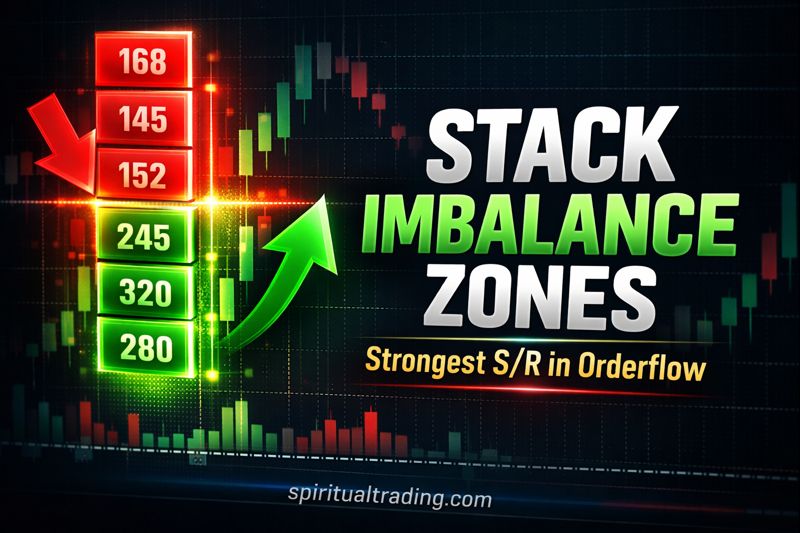
A stacked imbalance shows aggressive, one-sided buying or selling, concentrated across multiple price levels inside a single candle.
Whenever this stacking happens, it exposes:
- Where large traders defended a level
- Where institutional algorithms loaded positions
- Where hidden liquidity was absorbed
These zones often become the turning points of the market, even after hours or days.
🔍 What Is an Imbalance? (Quick Refresher)
In a footprint chart, an imbalance appears when:
Ask volume ≥ 3× Bid volume → Buyer imbalance
Bid volume ≥ 3× Ask volume → Seller imbalance
This shows clear aggression and dominance on one side.
🔥 What Is a Stacked Imbalance?
A Stacked Imbalance is when two or more imbalances appear on consecutive price levels, all in the same direction.
Example:
- 200 × 50 → 4× (Buyer imbalance)
- 300 × 70 → 4.2× (Buyer imbalance)
- 260 × 60 → 4.3× (Buyer imbalance)
When these cluster together vertically, we call them buyer stacked imbalances (BSI).
They act as strong demand zones.
Similarly, seller imbalances stack downward and form resistance zones.
🧠 Why Stacked Imbalances Are the Strongest S/R
Stacked imbalances are powerful because they represent:
✔ Institutional entry footprints
Big players don’t buy/sell randomly—they build positions over multiple price levels using aggressive orders.
✔ Large inventory holding zones
When price returns, institutions defend their positions, creating strong reactions.
✔ High-confidence rejection areas
A stacked imbalance in a wick often signals a trap or a deliberate stop sweep.
✔ Most accurate micro-support/resistance
Even when traditional S/R breaks, imbalances frequently still hold.
🌐 Types of Stacked Imbalance Zones
1. Bullish Stacked Imbalance (Demand Zone)
Appears when buyers aggressively hit the ask across 2–5 levels.
Works best in:
- Uptrends
- Pullback entries
- VWAP / POC bounces
2. Bearish Stacked Imbalance (Supply Zone)
Appears when sellers dominate across multiple levels.
Best used for:
- Trend continuation shorts
- Breaker block confirmation
- Liquidity sweep reversals
3. Wick-Based Stacked Imbalance (Trap Zone)
Imbalances in the wick = fake move + real institutional absorption.
These are extremely powerful reversal zones.
🎯 How to Trade Stack Imbalance Zones (Step-by-Step)
Entry Method 1 — Pullback to Imbalance Zone
- Identify a 2–5 level stacked imbalance
- Mark the full price range as a zone
- Wait for price to return
- Enter when a fresh footprint absorption/imbalance appears
This gives sniper precision entries.
Entry Method 2 — Trend Continuation
- Market is trending (higher highs / lower lows)
- Look for stacked imbalances forming with the trend
- Enter on retest of the imbalance
- Target next volume cluster or POC
Stack imbalances are the engine of trend continuation.
Entry Method 3 — Liquidity Sweep + Stack Imbalance
- Price sweeps a high/low
- On the footprint: stacked imbalances appear the opposite direction
- Enter immediately after confirmation candle
This is the highest win-rate setup for many institutional traders.
📌 Where to Place Stop-Loss
For bullish stacked zones:
- Below the lowest imbalance level
For bearish stacked zones:
- Above the highest imbalance level
Because this is where institutions place their defense.
🎯 Take Profit Strategy
- TP1 → Opposing imbalance
- TP2 → POC / VWAP
- TP3 → Previous swing high/low
- TP4 → Trend continuation target
🧩 Pro Tips for Maximum Accuracy
✔ Combine stacked imbalance + CVD divergence
If imbalance is bullish but CVD is bearish → liquidity trap → explosion possible.
✔ Use only 15m → 5m → 1m for execution
Higher timeframe imbalance = stronger zone.
✔ Avoid imbalance zones inside chop
Use market structure confirmation.
✔ Auto-shift POI when new stacked imbalances print
Fresh aggression > old aggression.
🧨 Big Mistakes Traders Make
🚫 Trading imbalance alone without context
🚫 Using imbalance zones in low volume sessions
🚫 Entering without absorption confirmation
🚫 Chasing imbalance candle instead of waiting for retest
⭐ Conclusion
Stacked Imbalance Zones are one of the most accurate, pure Orderflow-based support/resistance tools used by professionals.
They reveal:
- True institutional aggression
- Where liquidity was absorbed
- Where future reactions will occur
Mastering stacked imbalances helps you achieve:
- Sniper entries
- 2–5× better risk–reward
- True professional-level precision




One thought on “Stack Imbalance Zones – The Strongest Support & Resistance in Orderflow”