
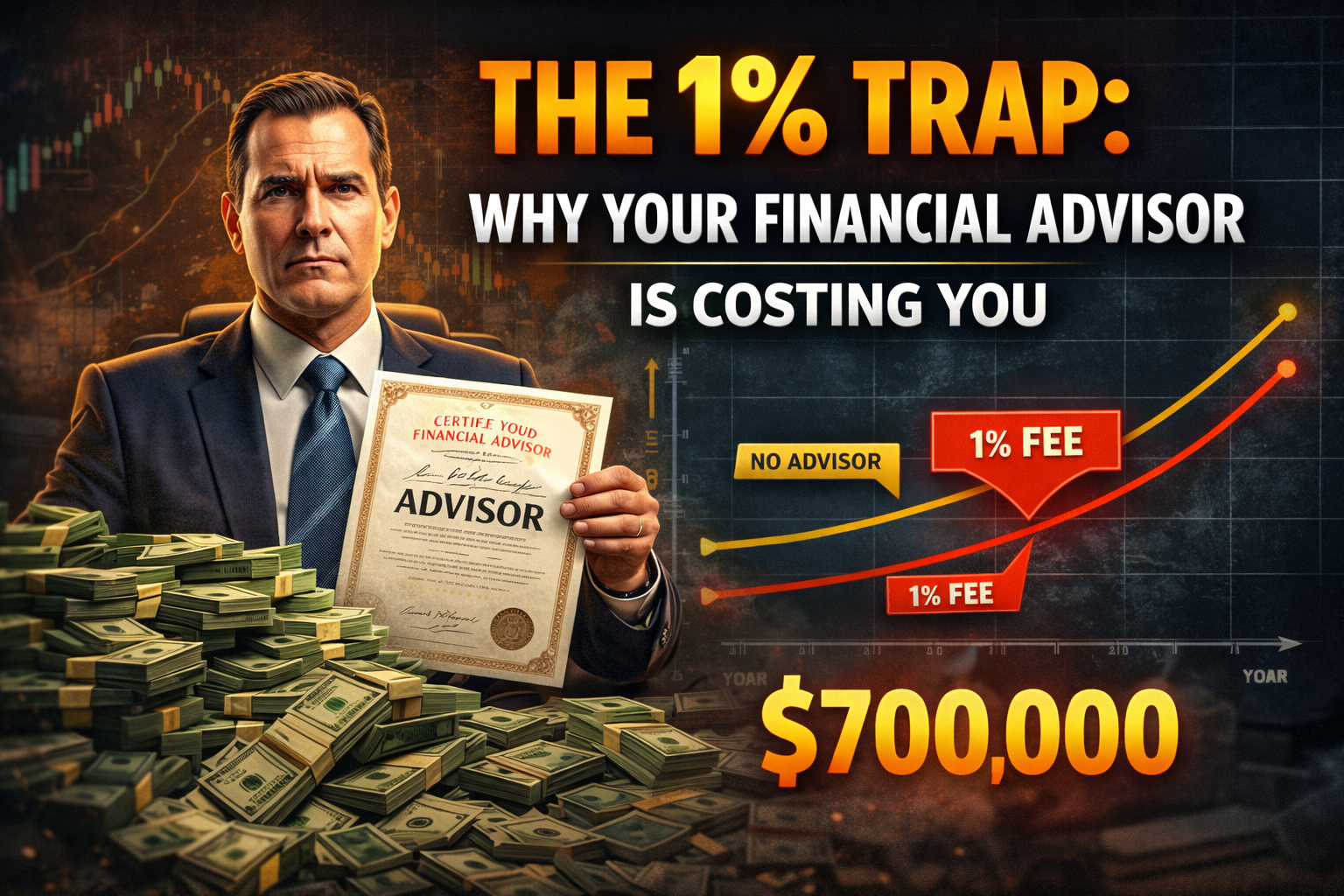
The 1% Trap: Why Your Financial Advisor Might Be Costing You $700,000
A 1% annual fee sounds small. On a mortgage it would be junk change. But invested over decades, that single percentage point compounds into real money—sometimes hundreds of thousands of dollars. This article explains exactly how the “1% trap” works, shows concrete math (so you can’t misremember the scale), summarizes what advisors do that can justify fees, and gives step-by-step options to protect your wealth.
TL;DR — the bottom line first
- A 1% annual drag on investment returns (for example 8% gross → 7% net) is not trivial: with typical contribution and timeframes it can wipe out hundreds of thousands of dollars of future wealth. Real examples below show differences of ~$270k (30 years, $1k/month) to ~$866k (40 years, $1k/month) depending on horizon and inputs.
- Small fee gaps (0.3%–1%) matter massively because of compound interest. Independent analyses and regulators repeatedly highlight fees as a dominant long-term wealth killer. (Morningstar India)
How the math works (plain, non-fuzzy numbers)
Compounding does two jobs at once: it grows returns and amplifies any drag on returns.
Scenario A — monthly investing example (simple & realistic):
You invest $1,000 every month.
- If your portfolio returns 8.0% annually, after 30 years your future value ≈ $1,490,359.
- If fees or other drags reduce that return to 7.0% annually, after 30 years your future value ≈ $1,219,971.
- Difference: $270,388 lost to that 1% drag over 30 years.
Same inputs but 40 years:
- 8% → $3,491,008; 7% → $2,624,813 → difference ≈ $866,195.
(These are standard future-value-of-an-annuity calculations — they show how a small annual percentage difference grows into a very large dollar gap over decades.)
— Real analysis showing the same pattern: tiny fee differences become very large dollar differences over multi-decade horizons. (Morningstar India)
Scenario B — lump sum example:
A $200,000 lump sum over 30 years at 8% grows to about $2,012,531. At 7% it becomes $1,522,451 — a $490,080 shortfall caused by the 1% gap.
These examples are conservative: higher returns or longer horizons make the cost even larger. (I used standard compound interest math so you can reproduce these numbers with any compound calculator.)
Where that “1%” actually comes from (and why it’s sticky)
Advisors charge in different ways: AUM fees (commonly ~1% for full-service advisors), hourly, fixed retainer, commissions, or hybrid models. Traditional human advisors commonly charge roughly 1%–1.5% AUM, while robo/advice platforms typically run ~0.15%–0.35% for automated portfolios. The gap between those numbers is where the long-term damage can originate. (ETNA)
But AUM isn’t the only cost: mutual fund expense ratios, ETF spreads, transaction costs, and product commissions (for some brokers) all add up. Industry research and consumer groups repeatedly show that fees across the stack — advisor + fund costs + transaction costs — are the real long-term killers. (Investsmart)
So are advisors worth 1%? What they claim to deliver
Good advisors argue they provide value in several ways:
- Behavioural coaching — preventing awful decisions (selling at bottoms, chasing tops) which can preserve returns.
- Asset allocation & rebalancing — systematic allocation that may raise net returns and reduce volatility.
- Tax and cash-flow engineering — tax-lot management, Roth conversions, tax-efficient withdrawals, etc.
- Planning & coordination — integrating retirement, estate, insurance and tax plans.
- Access & delegation — institutional ideas, private deals, or research otherwise unavailable.
Vanguard’s adviser-alpha framework suggests a skilled adviser can add measurable value (in some cases materially), but that value is irregular and client-specific — and not guaranteed to exceed 1% annually for many investors. In short: advisers can add value, but you must measure whether their value > fees. (Vanguard)
The hard truth: for many investors, 1% eats more value than advice returns
Multiple independent analyses show small fee differences add up. A fee that looks “cheap” annually can compound into a large absolute dollar loss decades later. Regulatory bodies and consumer researchers repeatedly highlight high fees and conflicted compensation (commissions, proprietary product pushes) as a key investor harm. (Investsmart)
Example real-world framing: if your advisor charges 1% AUM on $700,000, that’s $7,000/year — money that otherwise could keep compounding in your account. Over years and rising asset levels, that annual loss compounds and can materially lower retirement purchasing power. (See MarketWatch and practitioner writeups discussing AUM math and what to expect.) (MarketWatch)
Warning signs you’re in the 1% trap (ask these questions)
If your advisor charges ~1% or more, check for these red flags:
- You don’t get a written, itemized fee breakdown (advisor fee + underlying fund fees + platform fees).
- They recommend proprietary funds with higher expense ratios without clear rationale.
- You cannot easily get the same portfolio implemented by a low-cost provider (index ETFs) at a fraction of the price.
- They’re not a fiduciary (or won’t commit in writing to act as one). Ask about Form ADV and whether they’re an RIA. (Investopedia)
Practical alternatives (how to keep advisor benefits without bleeding returns)
1) Do the math first — run a fee impact scenario
Use a compound-interest calculator with your actual numbers (current balance, expected return, contribution schedule) and compare net outcomes at different fee levels (0.15%, 0.5%, 1%). Seeing the dollar gaps makes the choice factual, not emotional. (Many broker and fund sites provide calculators.) (ICICI Direct)
2) Negotiate fee structure
- Ask to switch from 1% AUM to a flat retainer or hourly / project pricing if you mostly need planning, not active management.
- Consider tiered AUM pricing (lower fee once assets exceed a threshold). Morningstar and industry articles discuss hybrid models that align incentives better. (Morningstar India)
3) Use a fiduciary or fee-only advisor
Fiduciaries are legally bound to prioritize your interests. They still charge fees, but their conflicts are (theoretically) lower and disclosure should be cleaner. Confirm their fiduciary status and read Form ADV. (Investopedia)
4) Robo + Human hybrid
If you want low cost plus occasional human guidance, many firms offer “robo” management (~0.15%–0.35%) with add-on CFP sessions for planning. This often gives you the largest slice of “advice value” at a fraction of 1% AUM. (Vanguard)
5) DIY with quality low-cost ETFs + occasional planner
If you’re comfortable implementing a straightforward plan, passive ETFs + periodic consultations with a planner (hourly or retainer) can be the cheapest way to get strategic advice while avoiding ongoing 1% AUM drag.
How to evaluate whether your advisor justifies 1% (quick checklist)
- Get the full cost — ask for a single number that captures advisor fees + underlying fund expenses + platform fees.
- Quantify value — ask the advisor to show, in writing, how their services will add more than the fee (examples: expected tax savings in $; projected plan outcome improvement). Vanguard’s framework can guide this conversation. (Vanguard)
- Compare alternatives — get quotes from a robo, a fee-only CFP on an hourly basis, and a low-cost RIA.
- Ask for references and sample work product — an actual financial plan excerpt (anonymized) and case studies with numbers.
- Check legal status — are they registered as an RIA? See Form ADV.
Real-world evidence & further reading
- Morningstar and other researchers show tiny fee differences compound to large gaps over decades. (Morningstar India)
- InvestSmart / ASIC whitepapers and similar consumer studies quantify how ongoing fees (1%–3%) erode portfolio value over 30 years. (Investsmart)
- Vanguard’s adviser-alpha research shows advisers can add value — but it’s uneven and often insufficient to justify high, ongoing AUM fees for many investors. (Vanguard)
- Practical commentary about hidden or layered fees and how they reduce net return is available from advisors and consumer writers. (RobBerger.com)
Action plan — next 30 days
- Get the true fee number (advisor + underlying funds) and run the compound impact for your situation (I can run it for you if you give current balance, contributions, expected gross return, and horizon).
- Ask your advisor for a written “value justification” — one page showing what they will do and the expected $ benefit. If they can’t provide this, treat the relationship as negotiable.
- Get 2 alternatives: (a) a robo/advisor quote; (b) a fee-only CFP hourly quote. Compare net outcomes.
- Decide: Keep full service only if the advisor’s documented value clearly exceeds the fee gap over your horizon.
Final thoughts
The “1% trap” is a real phenomenon — not because advisors are always bad, but because compounding magnifies small differences and fees are often the most predictable negative factor in your portfolio’s future. The right advisor can be worth far more than 1% in certain cases (complex tax situations, large estates, behavioral coaching where you would otherwise make costly mistakes). But many investors would be better off with a lower-cost solution plus one-off planning sessions.