
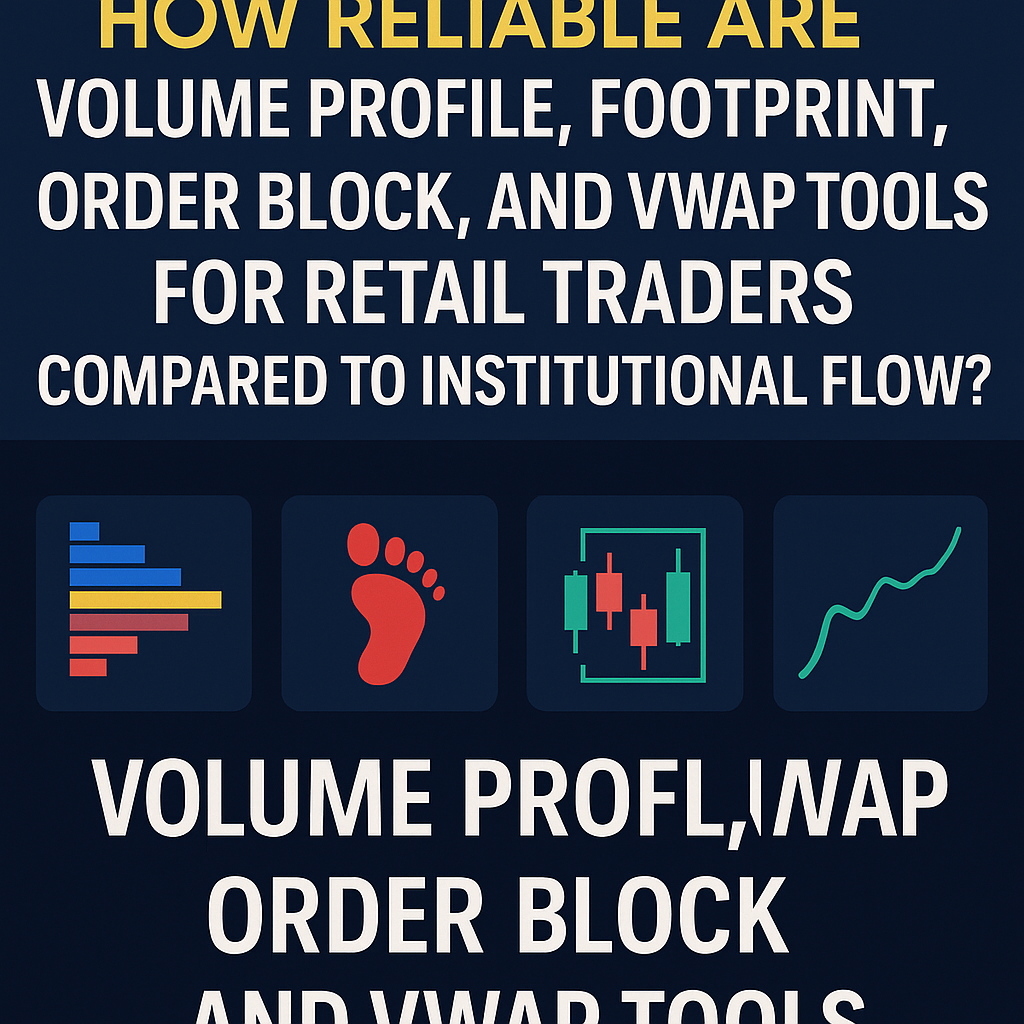
How Reliable Are Volume Profile, Footprint, Order Block, and VWAP Tools for Retail Traders Compared to Institutional Flow?
Every retail trader dreams of seeing what institutions see.
Tools like Volume Profile, Footprint charts, Order Blocks, and VWAP promise to reveal where “smart money” is buying or selling.
But how much truth is there in that belief?
In reality, institutions and retail traders do not operate on the same data layer.
What retail sees as “institutional footprints” is often just the afterglow of large-scale market activity.
Let’s explore whether these tools are reliable and how to use them intelligently.
🔹 1. Institutional vs. Retail Data Access
| Aspect | Retail Traders | Institutional Traders |
|---|---|---|
| Data Source | Aggregated & broker-filtered | Direct market access (DMA), real-time feed |
| Depth-of-Market | Limited visibility | Full order book, Level II, iceberg detection |
| Execution | Manual or semi-auto | Algorithmic execution with microsecond precision |
| Objective | Find opportunity | Create & control liquidity |
👉 Bottom line:
Retail traders see processed data, while institutions see raw order flow.
So what we call “volume” is merely the surface activity — not the true intent.
🔹 2. Volume ≠ Intention
A common retail trap is assuming high volume means institutional entry.
In truth, institutions often create volume spikes to attract liquidity.
For instance:
- A surge in delta might indicate strong buying…
but it could actually be distribution, where smart money sells into retail buyers.
Retail volume tools show the effect, not the cause.
🔹 3. VWAP — The Institutional Benchmark
VWAP (Volume Weighted Average Price) is the execution benchmark for large funds.
They aim to fill orders near VWAP to avoid impacting market price.
For retail traders, VWAP can:
- Act as a bias anchor (above = bullish, below = bearish)
- Define mean reversion zones
- Provide confluence with session high/low or POC levels
However:
Because VWAP is public, it becomes a self-fulfilling magnet — sometimes even a trap.
Best use:
Combine VWAP with volume clusters, order blocks, and session timing for context-driven trades.
🔹 4. Order Blocks — Myth vs Mechanism
Order blocks gained fame through “Smart Money Concepts” (SMC) and ICT-style trading.
Institutions don’t draw rectangles on charts — their algorithms build or unwind positions across price bands.
But the order block concept remains valid if applied with confluence.
✔️ Valid Order Block Characteristics:
- Appears after liquidity sweep
- Shows displacement (strong candle move)
- Aligns with volume imbalance or delta divergence
- Often confirmed by VWAP or POC overlap
Used blindly, OBs become false anchors; used correctly, they reveal institutional absorption zones.
🔹 5. Footprint Charts — Precision or Illusion?
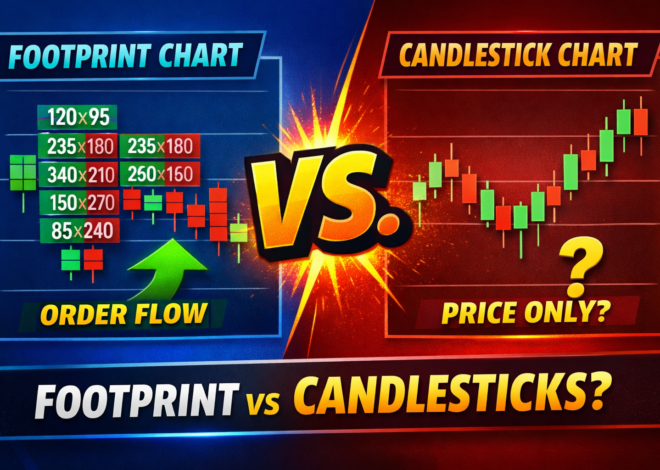
Footprint charts show bid/ask delta at each price level, which looks highly sophisticated.
However, their reliability depends on data quality.
Retail footprint data (from TradingView, NinjaTrader, etc.) is often:
- Delayed or aggregated
- Missing iceberg orders
- Prone to misinterpretation (delta ≠ direction)
Institutions use raw tick-level data with millisecond timestamps — a massive advantage retail platforms can’t replicate.
Hence, footprint analysis can guide your context, not your trigger.
🔹 6. The Institutional Flow Paradox
Institutions:
- Don’t chase indicators
- Don’t react to volume — they create it
- Use algorithms to exploit retail clustering
So when many retail traders mark the same “order block” or “VWAP bounce,”
institutions can engineer fake moves to trigger stops, then reverse the market.
👉 This is why trading tools must be used probabilistically, not predictively.
🔹 7. Smart Framework for Retail Traders
Here’s how to make these tools actually work in retail context:
| Step | Tool | Purpose |
|---|---|---|
| 1 | Multi-timeframe VWAP | Align bias (daily + session VWAP) |
| 2 | Volume Profile (POC zones) | Identify institutional footprints |
| 3 | Order Block | Detect absorption & imbalance zones |
| 4 | Footprint Delta | Confirm direction with volume divergence |
| 5 | Session Liquidity Map | Time your entry with high-volume windows |
📌 Golden Rule:
Trade reaction to liquidity, not prediction of movement.
🔹 8. Context vs. Event
Instead of treating every volume spike as a signal, treat it as part of the market’s volume story.
Example workflow:
- Identify context — VWAP + POC + key liquidity highs/lows
- Spot event zones — OBs or FVGs where displacement happened
- Wait for confirmation — trap → divergence → breakout → entry
This transforms you from an “indicator trader” to a contextual analyst — exactly how professionals think.
🔹 9. Reliability Ratings
| Tool | Reliability (Retail Context) | Professional Notes |
|---|---|---|
| VWAP | ⭐⭐⭐⭐☆ | Excellent for intraday bias |
| Volume Profile | ⭐⭐⭐☆☆ | Reliable structural guide |
| Order Block | ⭐⭐☆☆☆ | Effective only with strict validation |
| Footprint Chart | ⭐⭐☆☆☆ | Useful context, not standalone |
| Institutional Flow Imitation | ⭐☆☆☆☆ | Illusionary for retail data feeds |
🔹 10. Final Verdict
Retail traders can’t replicate institutional order flow,
but they can understand and adapt to its behavior.
Use VWAP, volume profile, and order blocks as contextual guides,
not crystal balls.
The edge is not in the tool — it’s in how you interpret the story of liquidity and reaction.
🧭 Key Takeaways
- Retail data ≠ institutional flow
- Volume shows effect, not intent
- VWAP works best with context, not isolation
- Order blocks must confirm displacement, not just shape
- Footprint charts are powerful when used for divergence, not prediction
- Smart trading = probability + structure + timing
💡 Conclusion
Institutions move markets.
Retail traders follow the waves.
But if you understand where liquidity sits and how price reacts,
you can align with those waves — not fight them.
When used wisely, VWAP, Volume Profile, Order Blocks, and Footprint charts help retail traders interpret the market like professionals —
without pretending to be one.
#TradingStrategy #VWAP #OrderFlow #VolumeProfile #SmartMoneyConcepts #DayTrading #InstitutionalTrading #RetailTraders #TechnicalAnalysis #OrderBlock



One thought on “How Reliable Are Volume Profile, Footprint, Order Block, and VWAP Tools for Retail Traders Compared to Institutional Flow?”