
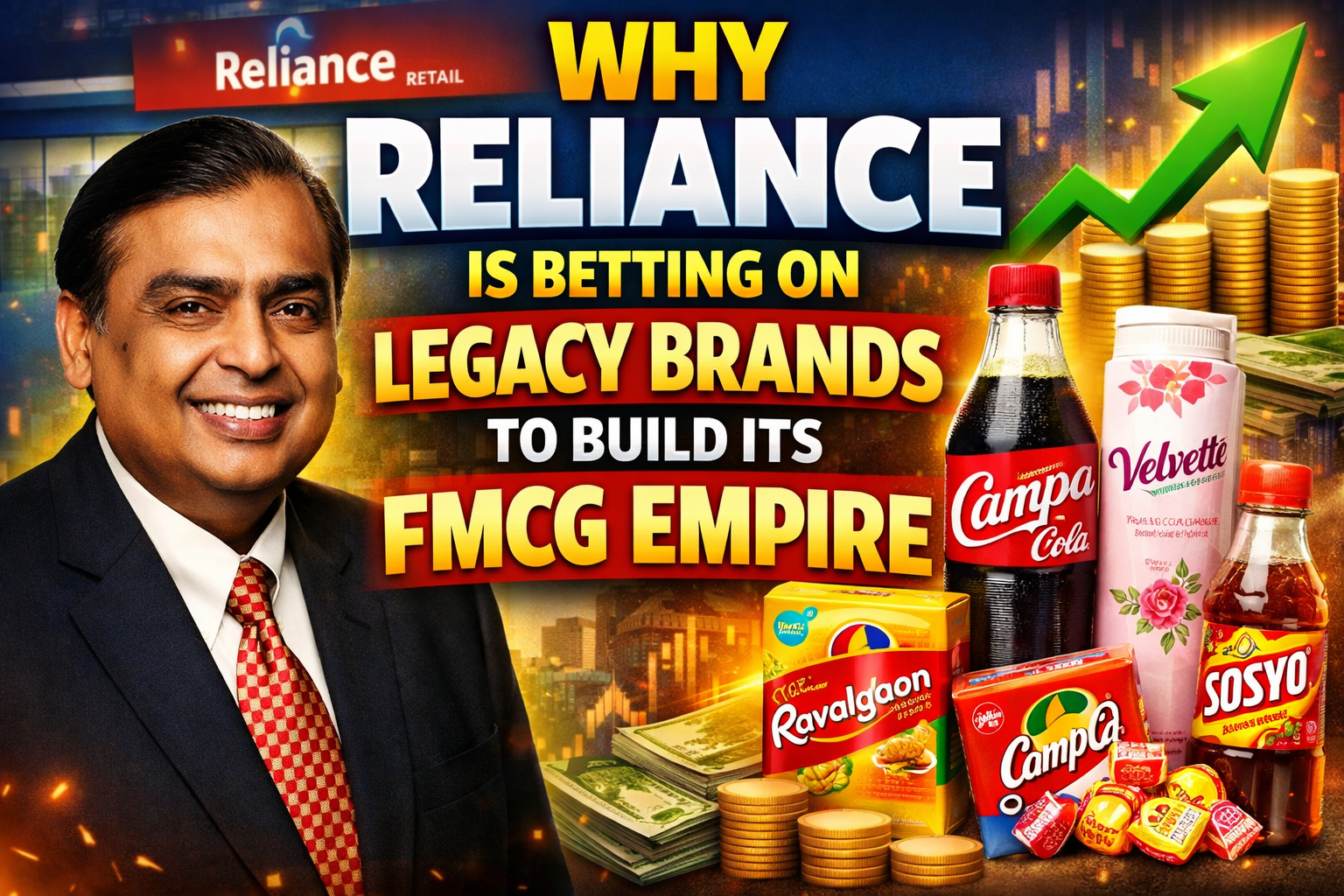
Why Reliance Is Betting on Legacy Regional Brands to Build Its FMCG Empire
India’s largest conglomerate, Reliance Industries, is pursuing an aggressive strategy to dominate the fast-moving consumer goods (FMCG) sector. Instead of building brands entirely from scratch, the company is acquiring and reviving legacy Indian brands and regional favorites—from beverages to personal care products. Through its consumer arm, Reliance Consumer Products Ltd (RCPL), Reliance aims to challenge established FMCG giants such as Hindustan Unilever, ITC Limited, and Nestlé India.
This strategy—often described as “nostalgia-driven growth” combined with distribution dominance—has already started producing rapid results. In just two years, RCPL’s consumer brands portfolio has crossed ₹11,000 crore in revenue, signaling how quickly Reliance is scaling its FMCG ambitions. (Whalesbook)
Below is a detailed look at why Reliance is betting big on legacy regional brands and how this strategy could reshape India’s FMCG landscape.
1. Leveraging Nostalgia and Consumer Trust
One of the biggest advantages of legacy brands is existing consumer recall and emotional connection. Many of these brands were household names in India before fading due to globalization or competition from multinational companies.
A prime example is Campa Cola. Once a dominant soft drink in India during the 1970s and 1980s, the brand lost ground after global giants entered the market in the 1990s. (Wikipedia)
Reliance revived Campa as a value-focused beverage brand, quickly expanding it across the country. Because millions of consumers already remembered the brand, Reliance did not need to spend years building awareness.
Reviving such brands gives Reliance a key advantage:
- Instant brand recognition
- Emotional nostalgia among older consumers
- Trust built over decades
- Faster adoption compared to new brands
In markets like India—where trust strongly influences purchasing decisions—brand familiarity can be more powerful than novelty.
2. Faster Market Entry Compared to Building New Brands
Creating a new FMCG brand from scratch typically requires:
- Years of marketing investment
- Building supply chains
- Consumer education
- Massive advertising budgets
By acquiring legacy brands, Reliance essentially buys brand equity and recognition.
For example, RCPL has revived or acquired several established names such as:
- Campa Cola – beverages
- Velvette – personal care products
- Sosyo – regional soft drinks
- Ravalgaon – confectionery
Instead of waiting years to build brand recall, Reliance can relaunch these brands immediately and scale them nationwide using its retail ecosystem. (The Economic Times)
3. Using Aggressive Pricing to Disrupt the Market
Reliance is combining legacy brand recall with price disruption, offering products 20–30% cheaper than competitors in many cases. (The Economic Times)
This strategy mirrors the company’s earlier disruption in telecom through Reliance Jio.
In FMCG, aggressive pricing helps Reliance:
- Gain market share quickly
- Target value-conscious consumers
- Undercut multinational competitors
- Increase shelf penetration in kirana stores
For example, Campa beverages are priced significantly lower than competing soft drinks from Coca-Cola and PepsiCo, enabling Reliance to rapidly expand its share in the beverage segment. (Whalesbook)
4. Power of Reliance’s Massive Distribution Network
One of Reliance’s biggest strengths is its unmatched retail infrastructure through Reliance Retail.
The company operates:
- Thousands of physical retail stores
- A vast wholesale network
- Deep penetration into kirana shops
- Online commerce platforms
This distribution power allows Reliance to launch products nationwide almost instantly, something smaller FMCG players struggle to achieve.
Once Reliance revives a legacy brand, it can rapidly scale through:
- Reliance Smart stores
- JioMart online platform
- Regional distributors
- Millions of small retailers
This speed of scale is a major reason why legacy brands can quickly regain market presence.
5. Acquiring Regional Champions with Loyal Customer Bases
Another pillar of Reliance’s strategy is buying strong regional brands with loyal local followings.
India’s FMCG market is highly fragmented, and regional brands often dominate specific states. Reliance is acquiring these companies to gain instant regional market access.
Examples include:
- A majority stake in Udhaiyams Agro Foods for staples and grocery products. (The Economic Times)
- Strategic partnerships with regional bottled-water producers for new beverage launches. (The Economic Times)
By integrating these brands into its national network, Reliance can:
- Preserve regional identity
- Expand distribution nationwide
- Reduce supply chain costs
This strategy allows Reliance to build a national FMCG portfolio while retaining regional authenticity.
6. Building a Multi-Pronged FMCG Strategy
Reliance’s FMCG expansion is not limited to legacy brands alone. Instead, the company is using three parallel strategies:
- Reviving legacy brands (Campa, Velvette)
- Acquiring regional players (Udhaiyams, Sosyo)
- Launching new mass brands (such as Independence for staples)
This approach ensures that Reliance can compete across multiple segments including:
- Packaged foods
- Beverages
- Personal care
- Household products
Together, these moves are helping Reliance rapidly build one of India’s largest consumer goods portfolios.
7. The Long-Term Vision: A ₹1 Trillion FMCG Giant
Reliance sees consumer products as the next major growth engine after telecom and retail. The company has even reorganized its consumer business into a dedicated entity to attract specialized investors and accelerate expansion. (Reuters)
The ultimate goal is clear:
to create a mass-market FMCG powerhouse capable of rivaling global giants operating in India.
By combining:
- Legacy brand equity
- Aggressive pricing
- Massive distribution
- Strategic acquisitions
Reliance is attempting to build a consumer empire at unprecedented speed.
✅ Conclusion
Reliance’s bet on legacy regional brands is not just about nostalgia—it is a carefully designed growth strategy. By reviving trusted names, acquiring regional champions, and leveraging its unparalleled retail network, the company can scale faster than traditional FMCG players.
This strategy allows Reliance to shortcut the long and expensive process of brand building while capturing market share in one of the world’s fastest-growing consumer markets.
If the strategy continues to succeed, Reliance could soon emerge as one of India’s most powerful FMCG companies—challenging decades-old industry leaders and reshaping the competitive landscape.